
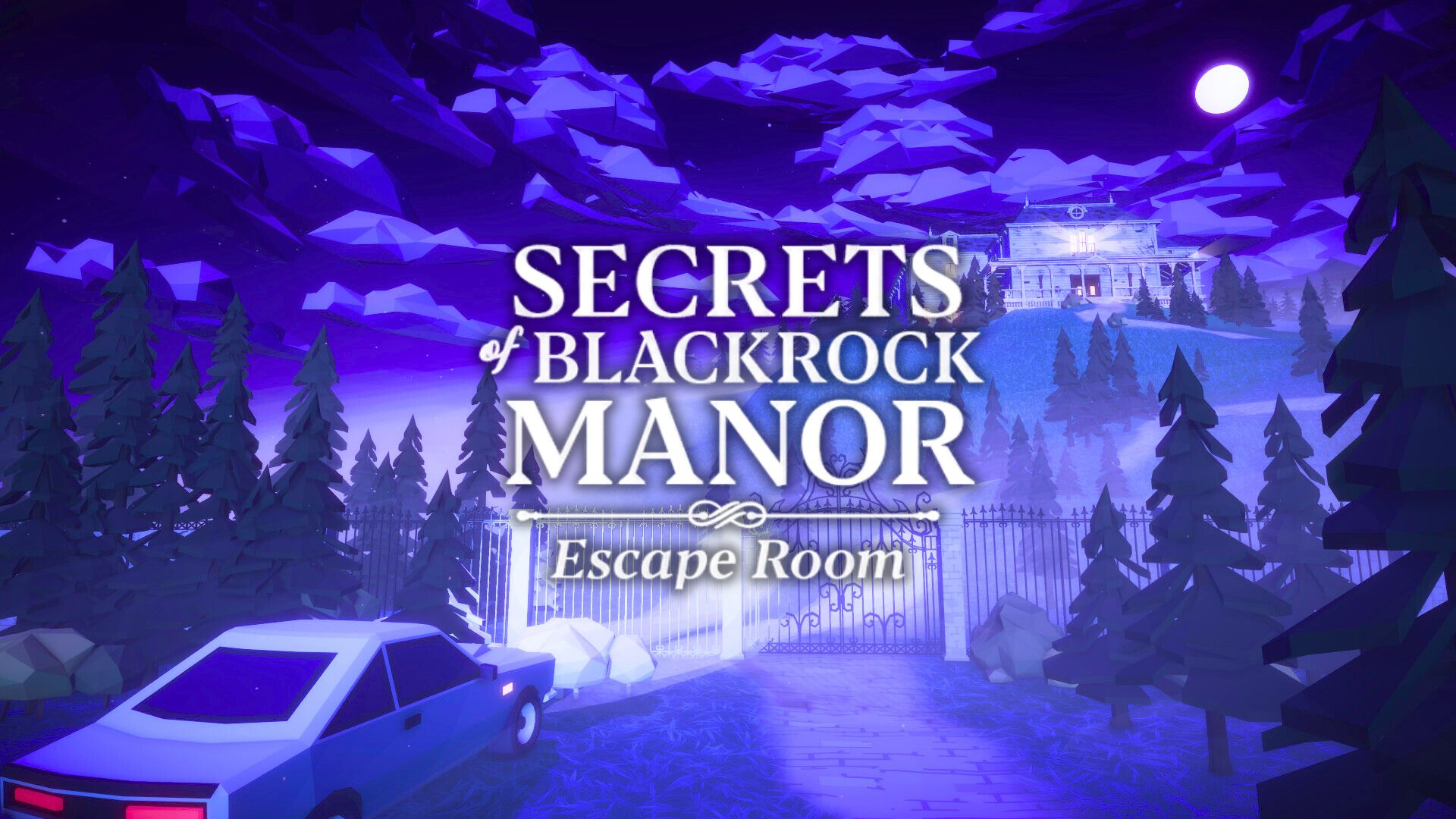
Secrets of Blackrock Manor – Escape Room is an intriguing, atmospheric, puzzle-focused mystery game developed and published by Biri Biri, that knows exactly where it’s headed and seamlessly ushers the player from one clever puzzle to the next. At first glance, the game feels like a Resident Evil title without the monsters and combat, but after completing every last mentally stimulating challenge and experiencing the resolution of the well-paced narrative, it proved to be far more than that.
Yes, perhaps it takes place in a big spooky mansion, and yes, it certainly leans on an unnerving soundtrack to develop and maintain a sense of lingering dread as the player explores the many hidden nooks and crannies while uncovering the secrets of Blackrock Manor, but it felt unique in its presentation. The art style was a pleasant, seemingly cartoon-inspired 3D modeling that was equal parts charming and mystifying. Every room was rich in both content and color, and it kept me pushing through puzzle after puzzle to see what was behind the next moving bookcase or locked door.

Secrets of Blackrock Manor is structured in similar fashion to the traditional escape room titles of the genre, but with a sometimes-chilling allure akin to a haunted house ghost story. The notes and environmental storytelling allow the player to piece together what events had transpired prior to their arrival, and with each puzzle solved, another new investigation was unveiled. Though the plot was shrouded in mystery, drip-feeding the player clues about the history of the manor and its previous inhabitants as they progressed, it never became stale or uninteresting.

The player enters the manor as a man seeking to find his fortune, or rather, discover the hidden fortune of Augustus Blackrock. Undone by the loss of his three children, Blackrock stashed his gold in a vault locked behind mountains of puzzles so no one could ever claim it, as his heart had grown cold… colder than it already was, as you discover throughout the game. The game became immediately compelling as I was thrust into a creepy crumbling mansion (one of my all-time favorite game settings), and I was there to hunt for treasure! It doesn’t get much better than that, far as I’m concerned.

The quest for loot quickly becomes a more intimate, deliberate unraveling of the tragedies that befell the Blackrock family and their once proud home. The game is split into eight rooms, all connected through cleverly concealed passageways that can only be accessed by you guessed it, solving each room’s series of puzzles. Much like the rooms, many of the puzzles are linked to hints and clues provided by the evidence gathered through solving other adjoining puzzles. Perhaps the solution to one puzzle that was discovered by observing a painting in the room will later be used to make the proper chess moves, play precise notes on a piano, or reorganize firearms to operate a nearby machine.

Each puzzle is creatively crafted to function on logic and observation rather than the arbitrary assumptions that many titles in the escape room genre often require. The game established the player’s trust by rewarding their investigation skills, never wasting their time with endless backtracking or hiding clues too far from the puzzles themselves. I quickly learned that if I simply paid careful attention to my surroundings, checked every drawer and cupboard, and didn’t let the scary music distract me, I was able to consistently progress with relative ease.

This is not to say the puzzles weren’t challenging however, as many were based around image recognition, mathematics, mirroring, etc., but they were built in such a way that they never felt impossible because whenever I got held up, I’d just take another stroll around the room and the clues would present themselves to me as I opened my eyes a little wider. When I first entered the manor there were only a handful of brainteasers and color matching elements, but with each new room I entered there was a steady difficulty curve at play, and the puzzles started to become multi-stage challenges that required critical thinking, so they never again felt like busywork. It’s this fair approach to the puzzle design that really made it stand out as one of my favorite escape room games to-date.

It was complex enough for veterans of the genre but remained approachable enough for new players without having to hold their hand too much. That’s not to declare that every single puzzle landed flawlessly. The dice and rune puzzles were personal frustrations for me, as well as some of the musical challenges, thanks to the overlap with the soundtrack and the slightly specific inputs that were honestly more finicky than difficult.

Some of the interactions stretched the limits of logic a bit further than others, but they were outliers to be certain, and there was a relatively balanced hint function that could be used when I felt I was spending too much time on one solution. It wasn’t the instant spoiler button like lots of other escape room style games have, and it really just functioned as a subtle nudge in the right direction, so I still felt the satisfaction of uncovering the mysteries for myself.

Visually, as I shared before, the game opts for style and individuality over realism. The intentional decision to present the otherwise creepy setting in a crisp, colorful, and often times cozy manner, made the puzzles pop and eliminated the stress of wandering through the darkness with a flashlight and digging through the rubble of the crumbling foundation as many other titles would have the player do. In an environment densely populated with puzzles, clarity is everything if the developers don’t want their players stuck for hours on end just to pad the length of their game, and this game had clarity for sure.

The lack of overly textured hyper-realism was certainly appreciated in this style of game, as I found each room to be distinct and fascinating to explore, but never felt lost in what I was doing. Whether it was the guns displayed on the walls of the office, the antiques scattered throughout each room, or the puzzles themselves (which often have crossover with the décor), everything had its own unique form and function. The finer details such as the placement of notes and key items, as well as the environmental storytelling presented through the many clues left behind, felt as though they were able to reveal a more immersive and enticing narrative than cutscenes even would have.

The game also had controller and Steamdeck support, but I was too impatient to set it up and just jumped in with mouse and keyboard. The game controlled smoothly, and the first-person perspective aided in the immersion, making the game less about the player and more about the manor itself. Though the story takes a bit of a backseat to the puzzles, it was woven seamlessly into the experience in such a way that never felt half-baked or forced. Each room I completed provided deeper insight into the grief and paranoia of the family and their accompanying tragedies, as well as delving into the consequences of greed, obsession, and the denial of love.

By the time I hit the ending scene, I had a feeling I knew what was coming, but that was okay because it didn’t feel predictable; it felt like I used my skills of deduction and solved the case before actually reaching its conclusion! For some the experience will take around three to five hours, though I’m an old hand at these types of games so I finished it around an hour and a half, and that was fine for me because it felt the perfect length for what it succeeded in accomplishing.
Secrets of Blackrock Manor‘s qualities far outweighed its negatives, which was so utterly refreshing from an indie developed title of the genre. It respected my intelligence but wasn’t ashamed to extend a helping hand when necessary. It played fairly but consistently challenged me with is bit of progress I achieved. In the end, what Biri Biri created is a chance at exploring an atmospheric puzzle box with narrative secrets worth uncovering. It’s an escape room game that I feel like I could play again, not because the puzzles change on subsequent playthroughs (though that might be a cool addition down the line), but because exploring each room provided a feeling of wonder that I truly enjoyed.

Whether it be the music, the sound effects, the decorative displays, they all felt reminiscent of those nostalgia-inducing memories from classics like Resident Evil or Metal Gear. I know it may seem silly to compare, but the sound design, the art direction, and the gameplay all worked in a really cohesive way to showcase an excellent experience. For those reasons, I’m giving Secrets of Blackrock Manor – Escape Room an 8.5/10 for achieving excellence without the need of a huge studio budget or flashy gimmicks. It’s simply a fun time.