
Reviewed on PC.
First Impressions: Vampire Survivors Meets Mad Max Hovercraft Chaos
I’ll be honest, I didn’t fully understand what S.C.A.D. was trying to be during the opening hour.
Then suddenly it clicked.
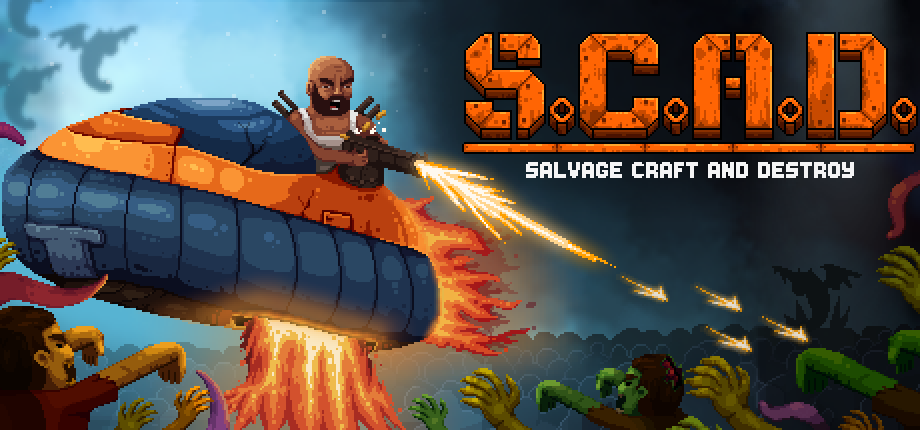
This thing is basically a strange cocktail of Vampire Survivors, roguelikes like Slay the Spire, and vehicular combat games all mashed together inside a dusty post-apocalyptic scrapyard full of zombies and hovercrafts.
And somehow… it works.

The Core Loop Is Ridiculously Addictive
The entire game revolves around exactly what the title promises:
Salvage. Craft. Destroy.
You fly around in your hovercraft blasting enemies apart, grappling scrap toward yourself like some kind of wasteland Spider-Man, collecting resources, levelling up, and slowly turning your barely-functioning junk machine into an absolute monster.
Movement feels simple at first—WASD to move, left click to fire, space to dash, but once you start using the grapple hook properly, the flow of combat becomes way more satisfying than I expected.
Zipping toward salvage while weaving through hordes of enemies feels great.

The Hub World Actually Matters
One thing I really appreciated is that the hub area isn’t just menu screens pretending to be gameplay.
Every building has a purpose and every NPC slowly becomes important to your runs.
You’ve got Hovick at the Vehicle Store upgrading your sad little starter hovercraft “BrainRoach,” which genuinely starts off feeling like it’s held together with duct tape and prayers.
Then there’s Krafton at the Crafter, where you buy and scrap weapons. Bartholomaw handles crewmates, which are required to actually operate certain weapons on your vehicle. Different crew types suit different loadouts, which adds a nice bit of strategy.
And finally there’s Mayor May, who essentially acts as the game’s encyclopedia, helping explain systems and enemies you’ve discovered.
Honestly, for a smaller roguelike, there’s a surprising amount of depth here.
Runs Feel Dynamic Thanks To The Different Modes
Each region branches out on a map very similar to Slay the Spire, letting you choose different event types as you progress.
And thankfully, the variety keeps things fresh.
Timed survival missions throw waves of enemies at you until the clock runs out. Escort missions have you defending massive moving hovercrafts. Defensive maps feel closer to tower defense survival modes, while capture zones force you to hold positions against swarming enemies.
Then there’s “Destroy the Nest,” where giant enemy spawning structures become your main objective.
Every mode feeds into the same loop of collecting resources and upgrading your build, but they all push you to play slightly differently.

The Upgrade System Has That “One More Run” Energy
This is where the game completely grabbed me.
Every level-up during a run gives you choices between abilities in that classic Vampire Survivors style. New weapons, stat boosts, passive abilities—there always feels like there’s another combination worth trying.
Outside of runs, resources like Fuel, Metal, Plastic, and Scrap all feed into progression systems back in town.
Fuel upgrades your long-term modifiers, Scrap helps repair and tweak builds during runs, while rarer resources unlock stronger gear and hovercraft upgrades.
There’s constantly something to work toward.

Bosses Are Surprisingly Solid
I expected the bosses to just be giant bullet sponges.
They’re actually pretty decent.
Each one gets its own arena and comes with more complex attack patterns than I expected. They’re not Elden Ring levels of difficult or anything, but they’re engaging enough to feel like a payoff for surviving the rest of the region.
The Outpost Missions… Yeah, Not My Favourite
Not everything lands though.
The Outpost sections, which act as tower defense mini-games every few regions, easily became my least favourite part of the game. You’re placing spare weapons and crewmates into stationary defenses while holding back waves of zombies.
It’s not terrible—it just completely kills the momentum for me.
Every time I started getting fully locked into the fast-paced hovercraft combat loop, the game would suddenly slow things down with these sections.
Final Thoughts
S.C.A.D. feels rough around the edges in places, but there’s something seriously addictive underneath it all.
The combination of hovercraft combat, resource management, roguelike progression, and build experimentation kept dragging me back for “one more run” far longer than I expected.
Once the systems start opening up and the builds become more chaotic, it becomes incredibly hard to put down.
Definitely one to keep an eye on if you love roguelikes with lots of progression and experimentation.
8/10