
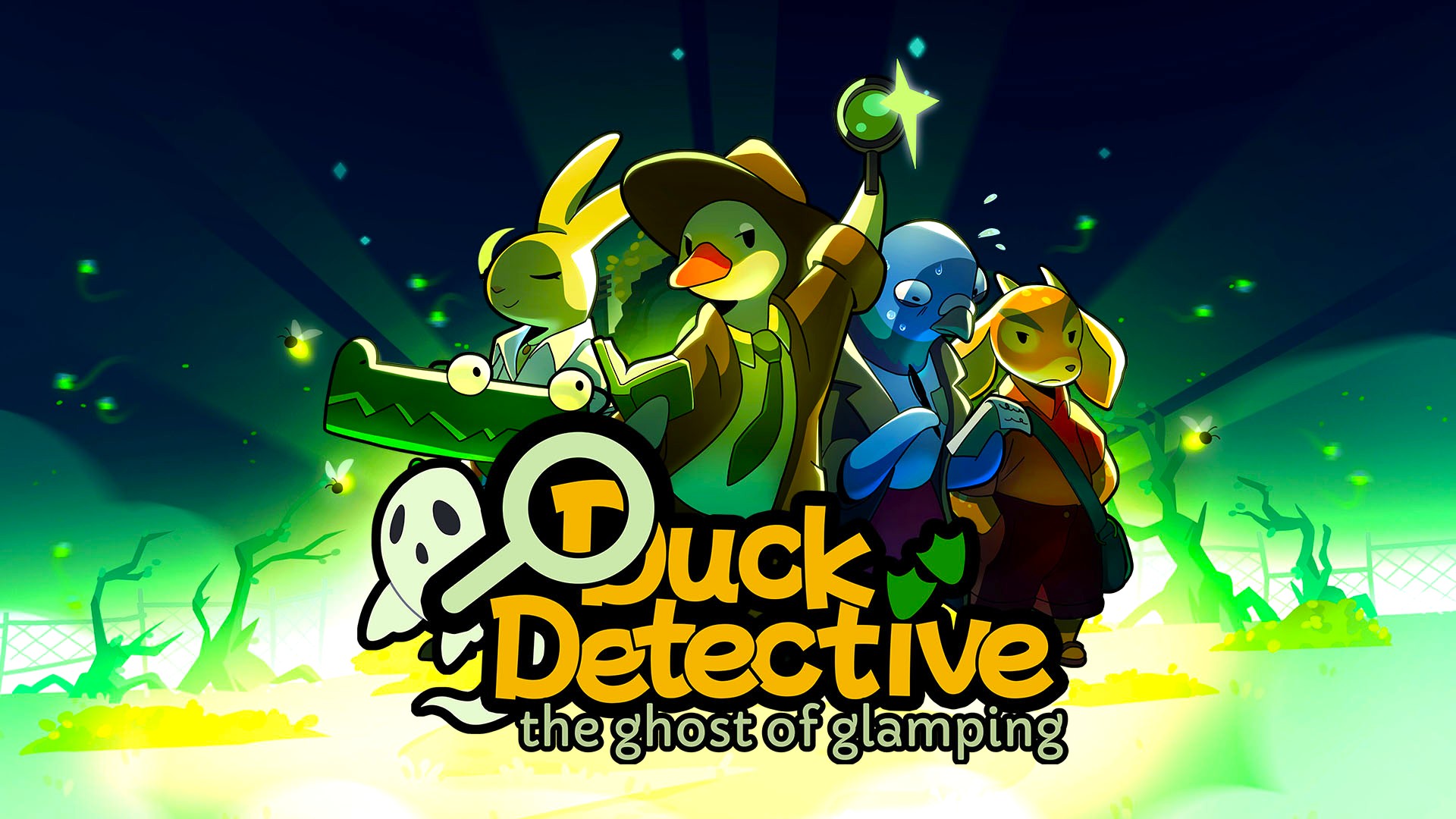
Duck Detective: The Ghost of Glamping is a standalone followup to Happy Broccoli Games‘ 2024 anthropomorphic animal sleuth comedy Duck Detective: The Secret Salami. The story follows Detective Eugene McQuacklin and his self-proclaimed “InvestiGator” roommate Freddy Frederson as they become entangled in one mystery after another and must use their expert powers of deducktion to quack this new case wide open! Well, Freddy’s really only there for moral support and to occasionally mess things up for McQuacklin, but that’s just part of his charm.
The Duck Detective is divorced, depressed, and determined to prove to everyone that he’s the best at what he does, all while trying to suppress his shame and sadness by feeding his near-crippling bread addiction and losing himself in his work. It’s almost as if his attempted solutions to his problems were the original causes of his problems to begin with, as is briefly explored with humorous dialogue throughout the game. Fortunately for our protagonist, he’s no longer alone.
As mentioned before, this time around he’s joined by his kind-hearted but slightly oblivious roommate turned sidekick Freddy, and the back-and-forth banter, as well as their often-contradictory viewpoints and clashing personalities make for a precious experience from start to finish. Frankly it’s hard to feel too bad for Eugene because once he’s on the case he is a man of focus, discipline, grit, and a boatload of cheesy film noir private-eye monologues that make for some of the most delightfully ridiculous and endearing moments in the game.

The game starts out with a quick gameplay tutorial in the form of the Duck Detective trying to figure out where Freddy is “forcing” him to go and begrudgingly be third wheel to his new girlfriend on what was meant to be a peaceful camping retreat. Unfortunately for Freddy and everyone else involved, nothing is ever quite peaceful when Detective McQuacklin is on the case.
Eugene turns every interaction that could be solved with a simple question and answer into a miniature case so he can keep his sleuthing skills sharp, and I guess show off to people? He kind of just seems like his whole personality revolves around solving mysteries, so even when there isn’t one, he creates one. Trust me when I say, it’s wonderful, hilarious, and surprising every time. It may seem like his self-aggrandizing demeanor is all just a mask to cover up his insecurities, and perhaps that’s true, but I’d be lying if I didn’t say that his detective skills are legitimately impressive.

One of the more intriguing aspects of that particular set of skills is Eugene’s abilities of “deducktion,” yes, I spelled that correctly, don’t forget that he’s a DUCK DETECTIVE! Regardless, deduckting functions much like when Sherlock Holmes utilizes his “mind palace” to piece together all of the evidence and observations collected throughout the duration of the case, or in this instance, many small and seemingly trivial cases that all somehow cleverly intertwine into one incredibly important revelation that may or may not have international consequences if not promptly addressed. Like I said, the duck’s good at his gig.
The bulk of the short but certainly sweet experience is spent keeping a keen eye out for keywords in conversations with potential suspects, interviewing individuals and cross-referencing collected data, spotting clues in the surrounding environments, identifying objects of significant importance to the case, and using Eugene’s trusty magnifying glass to more thoroughly examine the finer details of documents and other items that are pertinent to the investigation.

Once these tasks are completed with relative certainty, that’s when the Duck Detective must solve each step of the case by correctly plugging those previously attained keywords into his journal to reach a conclusion regarding the truth behind each encountered mystery. It’s like a game of Mad Libs, except the selection of words the player can choose from is limited by the quality of results turned up by their investigation. If none of the options make sense at the time, there are likely more clues to find and people to chat with.
While the player progresses through the plot, new and unique areas are made available for exploration, each equipped with their own individual mysteries to solve and clues to uncover. As the game is subtitled The Ghost of Glamping, you probably already guessed that the story was going to take place at some approximation of a campground, and if so, you would be mostly correct. With each successfully completed stage of the investigation, various areas open up, such as a handful of campers’ and glampers’ tents and “tents,” respectively, a collection of outbuildings and offices, the exterior campgrounds, a dusky beach, and even a supposedly haunted sanitorium, according to local legend.

Throughout the player’s investigation of these truly varied and brilliantly rendered locations, the Duck Detective will keep a journal to record all of the clues the player uncovers during the ongoing proceedings. Accompanying these clues are a tremendously handy, though not terribly necessary map, that indicates where the player might consider spending additional time to discover more key elements in solving their current case.
There’s also a story mode “difficulty” that simplifies the experience by providing the player with additional tips and aid, as well as a number of usable hints that allow for a far more streamlined experience intended for those select players who are less interested in gumshoe evidence gathering, and more intrigued by the hilarious, irreverent, and downright interesting storyline, and not to mention the compelling cast of characters found within the cleverly crafted narrative.

I say cleverly crafted for a handful of reasons, the chief one being the handling of the mysterious elements of the investigation, and the constantly evolving level of importance surrounding each phase of the case as it unfolded. For example, the “ghost” mentioned in the title of the game is spoken about early on, but its motives, actions, and even its existence are relatively uncertain and up to the player to discover on their own. That perplexing and enigmatic conundrum extends to nearly every single character in the game, suspect or not, they all have something to hide and something for the player to discover, regardless of whether it be innocent ignorance or nefarious intent.
Now, as I’ve explained, this game at its core is a narrative driven detective investigation experience, but the heart of the game lies in its whimsical, snappy, and consistently amusing sense of humor. The writing for each central character allowed for each wildly different person to express a sense of true individual identity, each complete with their own expert veteran voice actor to bring that identity to life.

The voice acting was incredible in this game by the way, featuring some popular names from anime and other game projects that are definitely worth looking into once you hop into the game and treat yourself to the exceptional cast of talent within.
It isn’t just the deft writing and inspired acting performances you need to keep an ear out for, the musical score was styled with such a fabulous 1940’s “Jazz Age,” film noir, “Detective Blues” style of music that really encapsulates the tone of those early crime dramas, while retaining a lighter vibe that allows for the punchy and often referential humor that consistently sought to parody the genre in which it was inhabiting.
The visuals were surprisingly stunning as well, due to the mostly two dimensional artstyle and animations, I didn’t have incredibly high hopes for the graphics going into my first playthrough. After walking around for a few moments in the very first scene, I realized what a great and clearly deliberate decision the studio made with the chance they took on that style of animation, and by the end of the game was left so delightfully impressed.

With the broad spectrum of colors, clean lines, imaginative character and environmental designs, a number of three-dimensional physics-based interactables sprinkled into the playing space, and a great deal of charm and heart poured into the overall direction of the title, I was left wanting more as the credits rolled.
After completing this one, I’m definitely going to go back and play the first game as soon as possible, and I am now so incredibly eager to get my hands on whatever they put out next in the series. I’m personally hoping for a spinoff called The InvestiGator: The Missing Duck Detective, where the player must set out on a new investigation, but this time as the well-intentioned, though perhaps not half the detective that Eugene McQuacklin is, Freddy Frederson, to find his roommate the Duck Detective!

With that said, I really just want to experience more of the wonderful storytelling, music, visuals, and performances that this game provided so well.
Oh, and you can make Eugene quack with the press of a button! It’s the best feature in the entire game, full stop. I could not stop doing it to Freddy whenever we’d enter a new area, causing him to jump in terror every time. I couldn’t help but quack up! Alright, I’m sorry… I know the duck puns are wearing out their welcome.
If you like cute games, funny games, detective games, animal games, or any combination of the bunch, then please do yourself a favor and check out Duck Detective: The Ghost of Glamping. The folks over at Happy Broccoli Games really cooked on this one, making it one of my new personal favorite indie darlings. Give it a try and I bet you’ll be hooked by the end of the first line read, I can almost guarantee it.
Final score 9/10