
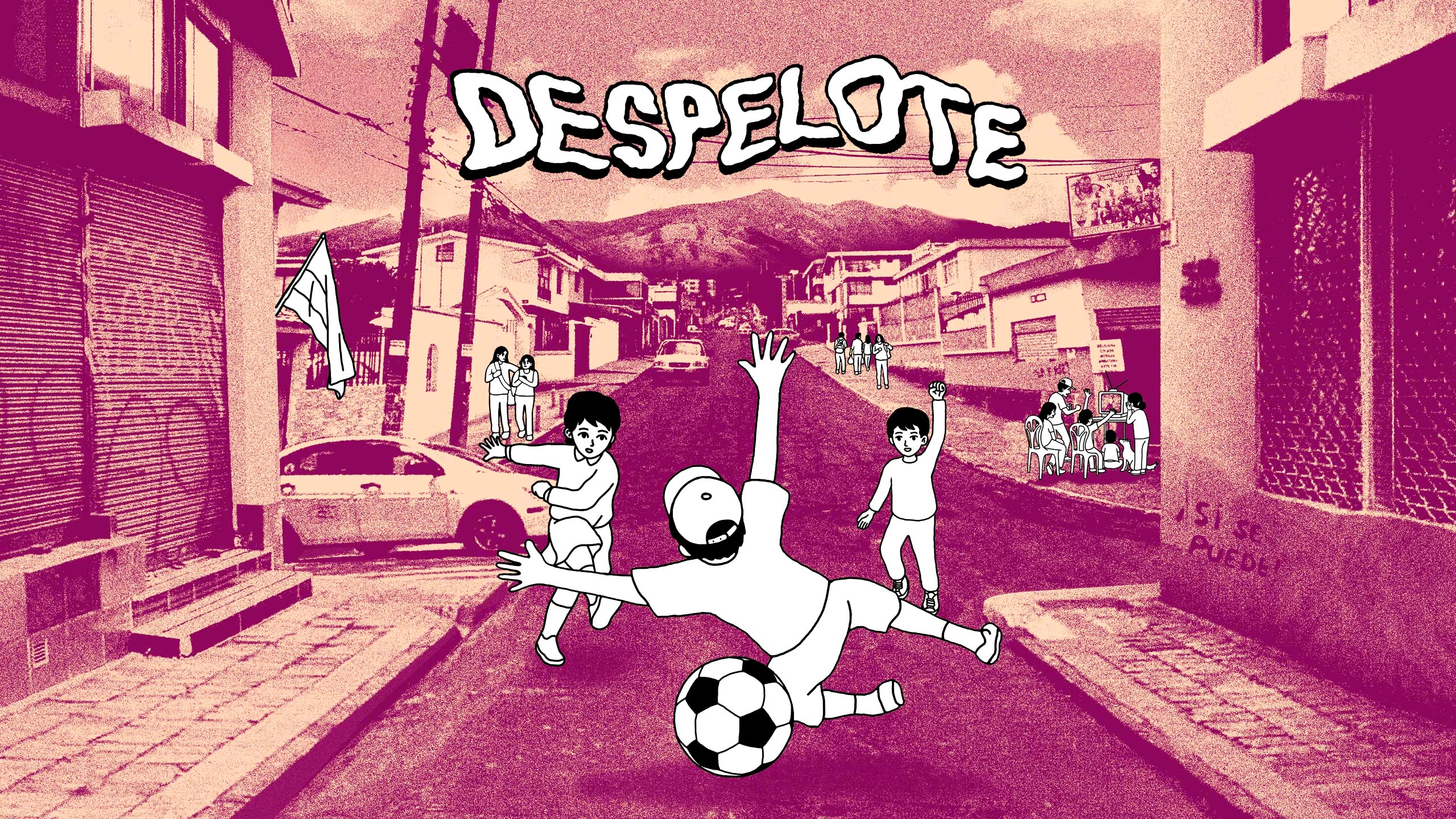
Developed by Julián Cordero and Sebastian Valbuen and published by Panic, Despelote is an autobiographical game about a young Julián Cordero’s life and fascination with soccer (football) while growing up in Ecuador during the country’s World Cup qualifying matches in 2001.
The central focus of the game is on Julián’s half-remembered version of events from his perspective as a child, and the majority of the player’s surroundings are hazy and grainy, apart from the people and objects that Julián was interested in and/or cared about enough to remember.
The game doesn’t solely focus on soccer however, as Julián’s family dynamic is explored through conversations overheard between his parents and sibling, as well as their interactions with him as the story jumps back and forth in time to different stages of his upbringing. These interactions also extend to friends, neighbors, and townsfolk as the world is built from the protagonist’s memory and impressions of those around him.

Using soccer as the focal point helped transcend cultural borders as it is one of the most popular and globally enjoyed sports in existence, and through its utilization Despelote surely became more relatable for many. For me however, though we are relatively close in age, I found that my upbringing was far too different from this Ecuadorian boy’s to fully grasp the impact of the story he was telling.
I thought the use of the colorful blurry graphics was intentional to represent the gaps in his memory, but I felt that it was distracting, unpleasant, and made the game far less approachable. The constant appearances of dialogue bubbles from everyone I walked past also left the screen even more cluttered and distracting, which worked to show how a child’s memory works, but doesn’t make for very enjoyable gameplay.
I also struggled with the controls in the actual soccer portions of the game, of which there were very few for a game so heavily focused on the sport, as they were clunky and poorly optimized. The first-person perspective was a useful tool to put the player in Julián’s shoes and allowed for decent enough exploration and interaction with objects in the environment, but it made for a much more difficult to control soccer experience that left me feeling disappointed.

The game also switched between the protagonist’s experiences in life, to him playing a soccer video game on his tv, often getting distracted or interrupted during his gameplay. My main issue with this mechanic, as it was actually more enjoyable than the rest of the game, was that all of the game’s achievements/trophies were tied to this occasional mini game. There’s no chapter select in Despelote either, which makes for revisiting this mini-game nigh impossible without having to play through the whole game up to the segments that allow the player to interact with it and then reload the checkpoint every time they are about to fail one of the requirements for the achievement/trophy.
The game failed to ever truly take hold of me, and though I was able to recognize the catharsis the developer must have experienced sharing his interpretation of important events in his life, I just wasn’t interested. I finished the game front to back and even sat through the credits, wondering if the mini game might become available to play at will after the fact. Instead, I was greeted with the start screen and no option to load any saves, only to restart the game.
At times the developer would speak to the player directly to update them on the state of Ecuador during times of great civil unrest, economic downturns, and cultural shifts, as to better shape the framework for this context sensitive experience. I found the historical aspects surrounding these details far more intriguing than the kid playing soccer and would have enjoyed (though that may be too strong a word), perhaps preferred to learn more about the Ecuadorian’s perseverance in the face of adversity, increased financial strain, and an uptick in street violence.

There is a tremendous lack of agency in Despelote, though as a child many of us felt we lacked agency and freedom of movement, but from a gameplay standpoint it made what already felt like a walking simulator turn into an on-rails walking simulator for small stretches at a time. The protagonist’s mother would take him by the hand and usher him through the park, into stores, out of cars, out of trouble, etc., and the player was just along for the ride to watch Julián get scolded time and time again for being a rambunctious kid who couldn’t seem to focus on anything but playing soccer and video games.
The kid couldn’t focus on his studies in school as he would stare aimlessly out the window, dreaming of kicking soccer balls, but finding himself becoming caged and closed in by the towering buildings and streets that come with living in an urban environment. The story also revealed how Julián would often be bullied with slurs and insults from classmates and people around town, as well as with physical attacks like shoving and tripping and many other things that frankly I think most of us have experienced at one point or another. It can be a bit jarring from a first-person gameplay perspective, but I suppose that works to better highlight how jarring it must have been from Julián’s real-life perspective as he lived through these experiences.
Julián never had a retort or comeback of any kind, nor any dialogue at all with any of the game’s many characters. He just observed and listened, kicked things around, kept himself distracted with the occasional video game session with his Tino Tini’s Soccer 99 cartridge (a reference to1994’s Dino Dini’s Soccer), and waited until adulthood to make a video game to report on what he experienced.

It was very disconnecting and broke any possible immersion I may have been able to develop as I ran around the town from house to park to back lot, kicking stuff and throwing things around. The Ecuador qualifying matches I mentioned earlier worked in a similar fashion, as they would pop on a television in a scene briefly, or I’d hear them on a radio nearby, and the scores would be updated for each match as a framing device to show the passing of time. With that said, it does make me realize a bit more even when writing this now, that Julián’s only true focus and interests all surrounded soccer, so of course it’s all he would see and hear.
This seems a likely reason why the narrator only briefly mentioned the economic and social turmoil that the country was undergoing at the same time as the qualifying matches were taking place. His relatively blissful childish innocence and ignorance of adult problems allowed his life to be about soccer, not struggle, even if everyone else around him was feeling it. Perhaps he experienced the suffering all along but chose to block these things out and only remember the things that brought him joy.
Regardless, none of that made for a fun game or an enjoyable narrative. Maybe fans of soccer or people that grew up in Ecuador in the late 90’s and early 2000’s might be able to enjoy it more than I did, but I just never found one character that I connected with or recognized. Maybe it was the art style that separated memory from reality in a comic book type of way, or perhaps it was just that I found the game and its characters to be uninteresting and lacking any truly memorable qualities; Ironic in a game based on memories.

Though I did have strict parents, I did grow up playing sports with neighborhood buddies, I did have a sister, I did play video games, all like Julián, I just didn’t understand his hyper-fixation on the sport of soccer. It’s not that I don’t understand the sport or the fun to be had with it, it’s just that I remember being more multi-faceted in my interests even at his age and wasn’t so disconnected from reality that I ignored my responsibilities and interacting with my family to pursue kicking things around in the yard.
Apart from the narrative that failed to ever engage my interest, the distracting graphics and jump-cuts between various periods of Julián’s life, and the poorly optimized first-person gameplay mechanics and soccer playing, I simply found the game to be too long. I am aware that it was only about an hour and a half to finish, but I stand by my statement. There were many extended sections of wondering around that could have been shortened to keep better narrative pace, or perhaps if the developers had eliminated the colorful blurry pixelated graphics and allowed the entire game to be free roam, going from one interactable character or event to another, then it would have been a more enjoyable experience.

In its defense, Despelote offered a look into the memory of the developer and allowed him to share the story he wanted to tell. It wasn’t as over-the-top and cliché as many young adult stories typically tend to be, and it was imaginative in its artistic design to say the very least. I just wish it had been more fun to run around as a kid and kick stuff; It sounds so much more fun than they were able to execute. I have played dozens, if not hundreds of these “slice of life” style narrative driven games, and I usually have such a great time with them. I love to experience history through the eyes of someone different from me; Different nationality, different time period, different upbringing, different cultural background, etc., but man did this game miss the mark.
Regardless, I found it to be a lackluster and boring experience that some may find to be quite enjoyable and intriguing if they were brought up with a greater interest in soccer (football) than myself. If it wasn’t for the story, the artistic distractions, and jarring constant dialogue and scene shifts, perhaps I would have enjoyed it even with the wonky controls, but as it stands, I didn’t care much for it at all.